
When AI Answers the Question, Make Sure It Cites You.
Your buyers are asking ChatGPT, Gemini and Google’s AI Overviews before they ever open a list of blue links. Those answers pull from a handful of sources. We make your site one of them — structured to be parsed, marked up to be understood, and credible enough to be quoted.
Why AI Search Changes the Job
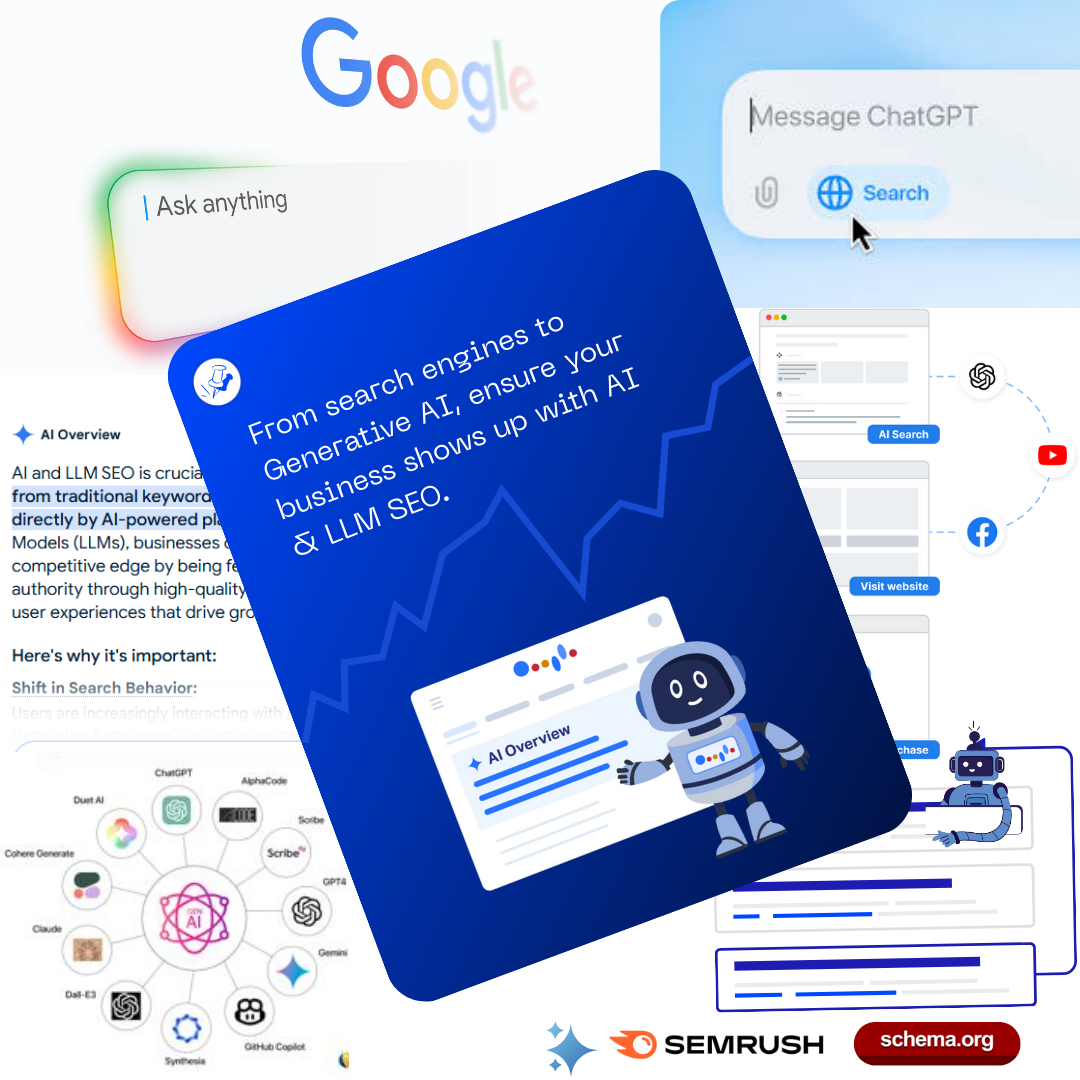
Built to Be Quoted, Not Just Ranked
What You Get With Generative AI SEO
Six workstreams that make your site legible to AI systems and credible enough to cite. This runs alongside classic SEO rather than replacing it — the technical foundations overlap heavily with Business SEO, and citations are won with the kind of content covered in Content Marketing & Optimization.
Find Out What AI Already Says About You
Most businesses have never checked. We ask the assistants the questions your buyers ask, and show you exactly who’s being cited instead of you.
Prompt Set & Baseline Testing
We build a prompt set from your real buying questions, then run it across the major assistants.
What we do:
- Map the questions your customers ask at each stage of the decision.
- Run them across ChatGPT, Gemini, Perplexity and Google AI Overviews.
- Record whether you’re mentioned, cited, or absent entirely.
- Capture a dated baseline so future gains are measurable, not anecdotal.
Competitor Citation Analysis
Somebody is being quoted for your topics. Their pages tell us why.
What we do:
- Identify which competitors and third-party sites get cited most often.
- Analyse the format and structure of the pages being pulled from.
- Spot the sources assistants lean on repeatedly — directories, reviews, press.
- Flag where a competitor’s weak page is beating your stronger one.
Gap Report & Priority Actions
A ranked list of what to fix, not a screenshot of chatbot answers.
What we do:
- Separate technical blockers from content and authority gaps.
- Rank fixes by how many target prompts each one affects.
- Identify quick wins where you’re nearly cited but not quite.
- Set a realistic target for which prompts we go after first.
Tell Machines Exactly Who You Are
Language models work with entities — defined things with defined relationships. If your business isn’t a clear entity, you’re a string of text that’s easy to overlook.
Entity Definition & Consistency
One unambiguous version of who you are, repeated everywhere it counts.
What we do:
- Settle a single canonical business name, description and category.
- Align it across your site, profiles, directories and press mentions.
- Resolve conflicting descriptions that make you look like two businesses.
- Connect people, services and locations into one coherent picture.
Structured Data Implementation
Schema is the most direct way to state facts a machine can rely on.
What we do:
- Implement Organization, Service, Person and FAQ schema properly.
- Use sameAs to link your profiles into one verified identity.
- Mark up authors and credentials so expertise is attributable.
- Validate everything — present but invalid schema does nothing.
Knowledge Panel & Third-Party Signals
Assistants corroborate what you say against what others say about you.
What we do:
- Work toward a Google knowledge panel where you’re eligible.
- Correct outdated facts on the third-party sites AI tends to trust.
- Build presence on the reference sites that carry disproportionate weight.
- Keep every external profile consistent with your canonical entity.
Topical Authority Mapping
Being cited on a topic requires demonstrable depth on that topic.
What we do:
- Define the two or three subjects you should genuinely own.
- Map full topic clusters rather than isolated posts.
- Fill the gaps that make your coverage look partial.
- Interlink the cluster so the relationship between pages is explicit.

Write Pages an Assistant Can Lift From
AI systems extract passages, not pages. Content built as one long argument rarely gets quoted. Content built as clear, self-contained answers does.
Question-Led Page Structure
Headings that match real questions, with the answer directly beneath.
What we do:
- Restructure key pages around the questions buyers actually ask.
- Lead each section with a direct answer before the supporting detail.
- Keep passages self-contained so they make sense quoted alone.
- Use clean heading hierarchy that maps to the topic structure.
Extractable Formatting
Tables, lists and definitions are disproportionately likely to be pulled.
What we do:
- Convert dense comparison paragraphs into structured tables.
- Break processes into numbered steps with clear labels.
- Add definition blocks for the terms your industry uses.
- Front-load specifics — numbers, timeframes, criteria.
Original Data & First-Hand Detail
Assistants have already read every generic explanation. They can only cite what’s uniquely yours.
What we do:
- Surface proprietary data, benchmarks and results only you hold.
- Turn practitioner experience into specifics nobody else can restate.
- Publish methodology so claims are verifiable, not assertions.
- Attribute content to named, credentialed authors.
Existing Content Retrofit
Most sites don’t need new pages. They need their best pages restructured.
What we do:
- Audit existing content for pages already close to being cited.
- Rework structure and formatting without losing current rankings.
- Add FAQ sections and schema to pages that lack them.
- Consolidate thin pages competing for the same question.

If AI Crawlers Can’t Read It, You Can’t Be Cited
A surprising number of sites block the very crawlers that feed AI answers — sometimes deliberately, usually by accident. This is the cheapest fix on the list.
Crawler Access Audit
We check exactly which AI crawlers can reach your content, and which are being turned away.
What we do:
- Review robots.txt for rules blocking AI user agents.
- Check firewall, CDN and bot-protection rules doing the same silently.
- Confirm server responses to each crawler rather than assuming.
- Present the trade-offs so blocking stays your decision, not an accident.
llms.txt & Crawl Directives
An emerging convention for telling AI systems what your site covers and where the good content lives.
What we do:
- Publish an llms.txt file mapping your key content — Rank Math already supports this on your setup.
- Set clear directives for which sections are open and which aren’t.
- Keep it current as the site grows.
- Track adoption as the standard settles.
Rendering & Content Delivery
Many AI crawlers don’t execute JavaScript. Content that needs JS to appear may as well not exist.
What we do:
- Test what each crawler actually receives versus what a browser shows.
- Move critical content into server-rendered HTML.
- Remove interstitials and gates that block automated access.
- Keep page weight low so full content is retrieved reliably.

Get Mentioned Where AI Is Already Looking
Assistants lean heavily on a predictable set of sources — review platforms, industry publications, community discussions. Presence there shapes what gets said about you.
Source Platform Mapping
Work out which sites are actually feeding the answers in your category.
What we do:
- Identify the domains cited most often for your target prompts.
- Separate the ones you can influence from the ones you can’t.
- Prioritise platforms by how frequently they’re pulled from.
- Audit what those sources currently say about you.
Review & Directory Presence
Aggregated third-party opinion is one of the strongest corroborating signals available.
What we do:
- Build presence on the review platforms that matter in your sector.
- Keep profiles complete and consistent with your canonical entity.
- Encourage reviews that describe specifics, not just star ratings.
- Correct outdated listings that contradict your current positioning.
Earned Mentions & Digital PR
Unlinked mentions still count here. Being discussed is the point.
What we do:
- Pitch original data and expert commentary to industry publications.
- Target the outlets and newsletters your buyers already read.
- Build named-expert presence for your key people.
- Pursue inclusion in roundups and comparison pieces.
Community & Discussion Presence
Forums and community threads are read heavily by AI systems. Handle with care.
What we do:
- Identify the communities where your category is genuinely discussed.
- Contribute expertise transparently — astroturfing backfires badly.
- Monitor threads where you’re mentioned and correct misinformation.
- Track sentiment in the discussions AI is most likely to draw on.

Measure Citations, Not Just Rankings
AI visibility doesn’t show up in a rank tracker. It needs its own measurement — repeatable prompt testing plus the referral traffic that follows.
Prompt Monitoring Over Time
The same prompt set, run on a schedule, so movement is provable.
What we do:
- Re-run your baseline prompt set monthly across each assistant.
- Track mention rate, citation rate and how you’re characterised.
- Compare against the competitors in the same answers.
- Flag the moment a competitor displaces you on a target prompt.
AI Referral Traffic in GA4
Traffic from assistants arrives with distinctive referrers. Most analytics setups lump it into “other”.
What we do:
- Configure GA4 to isolate AI assistant referrals as their own channel.
- Track landing pages, engagement and conversion for that traffic.
- Compare its behaviour against classic organic search.
- Identify which pages are actually earning the citations.
AI Overview Presence
Google’s AI Overviews change what a page-one ranking is worth.
What we do:
- Track which of your target keywords trigger an AI Overview.
- Record whether you’re cited within it.
- Monitor click-through changes on affected keywords.
- Adjust content where an Overview is absorbing your traffic.
Monthly Reporting & Iteration
This field moves fast. The reporting has to keep up.
What we do:
- Report citation rate, referral traffic and conversions in plain terms.
- Explain what moved, what caused it, and what’s next.
- Flag platform changes that affect your strategy.
- Reprioritise on evidence rather than a fixed annual plan.
How It Works
Four stages, from finding out where you stand to holding the citations you win.
Benchmark
We run your buyers’ real questions across every major assistant and record exactly who gets cited today.
Build Foundations
Entity definition, schema and crawler access — the technical groundwork that makes citation possible at all.
Earn Citations
Restructured content plus presence on the third-party sources AI systems already trust.
Track & Adapt
Monthly prompt re-testing and AI referral reporting, with priorities adjusted as platforms shift.
Why Work With Us on AI Search
We Turn Every Click, View & Scroll into Your Edge with Your Existing Data Existing Data Existing Data
We Test, We Don't Guess
Nobody has the algorithm for AI citation. So we run your actual buying questions across every assistant, record what happens, and work from evidence — not from a theory about how these systems might behave.
It Compounds With Your SEO
This isn't a separate budget line running in parallel. Clean structure and genuine authority lift classic rankings and AI citations together — the same work pays twice.
Foundations Before Tactics
Entity clarity, valid schema and crawler access do most of the work. We fix those before touching anything speculative, so the effort holds up even as platforms change.
Honest About the Unknowns
This field is eighteen months old and changing monthly. We'll tell you what's established, what's still a reasonable bet, and what nobody can promise — including us.
FAQ's
Is this different from regular SEO, or just a rebrand?
There’s real overlap — clean technical foundations and genuine authority help both. The differences are specific: AI systems extract self-contained passages rather than ranking whole pages, they weigh entity clarity and structured data more heavily, and they corroborate against third-party sources before citing you. So the content structure, the schema work and the measurement are all genuinely different. See Business SEO for the classic side.
Can you guarantee ChatGPT will recommend my business?
No. Nobody can, and anyone claiming otherwise is selling something. These systems are non-deterministic — the same prompt can return different sources on different days. What we can do is make your site technically legible, factually consistent and genuinely authoritative, then measure citation rate over time so you can see whether it’s moving.
Should I block AI crawlers to protect my content?
That’s a real trade-off and it depends on your model. If your business is publishing, blocking may protect revenue. If your business is being found by buyers, blocking removes you from the answers they’re reading. We’ll show you exactly what’s currently blocked and what each choice costs — but the decision stays yours.
How long before I see results?
Technical fixes — crawler access, schema, entity consistency — can show up in assistant answers within weeks, because these systems refresh sources frequently. Authority and citation building take longer, typically three to six months, since it depends on third-party sources updating what they say about you. We benchmark at the start so you can see the movement either way.
Free, No Obligation
Find Out What AI Says About You Right Now
Send us your domain and the questions your customers ask. We’ll run them across ChatGPT, Gemini, Perplexity and Google AI Overviews, and send back exactly where you appear, who’s being cited instead, and what’s blocking you.