
Meta Ads That Turn Scrolling Into Sales.
Nobody opens Instagram looking for you. That’s the challenge and the opportunity — you reach people before they start comparing options, but only if the creative earns the pause. We build ads people stop for, then send them somewhere built to convert.
Why Meta Ads Work Differently
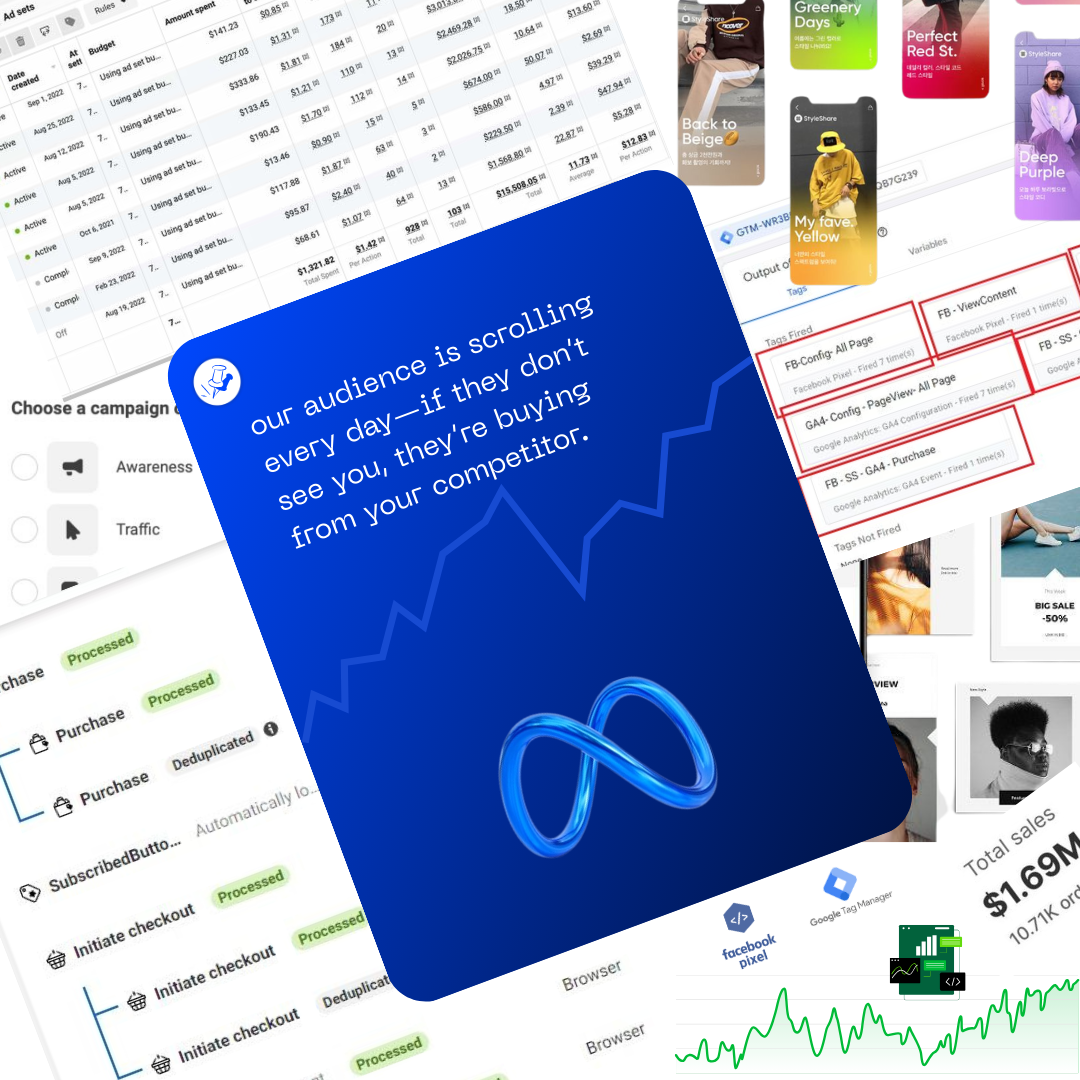
Creative, Targeting and the Funnel Behind Both
What You Get With Meta Ads Management
Six workstreams covering audiences, creative, campaign management, retargeting, tracking and the funnel that turns interest into revenue. Meta reaches people before they search; Google Ads catches them once they do. Run together, each makes the other cheaper.
Meta’s Algorithm Is Good. Feed It Properly.
Targeting has shifted from manual interest-stacking toward algorithmic delivery. That makes the quality of the signals you give it more important, not less.
Custom Audiences From Your Own Data
Your customer list is the most valuable targeting asset you have, and it costs nothing.
What we do:
- Upload and match customer and lead lists securely.
- Build audiences from site visitors, video viewers and engagers.
- Segment by purchase value so the best customers carry most weight.
- Refresh source data regularly so audiences stay current.
Lookalike Modelling
Finding more people like your best customers — the closest thing Meta offers to a shortcut.
What we do:
- Build lookalikes from high-value converters, not just any lead.
- Test tight and broad percentages to balance reach against quality.
- Layer lookalikes with location and demographic constraints.
- Rebuild them as your customer base grows.
Interest & Behaviour Layering
Useful when your seed data is thin, or when a niche needs explicit definition.
What we do:
- Research the interests that genuinely correlate with buying.
- Layer behaviours and life events where they matter.
- Avoid over-narrowing, which starves delivery and inflates cost.
- Test broad targeting against defined audiences — broad often wins now.
Audience Testing & Exclusions
Structured testing, and making sure your campaigns aren’t bidding against each other.
What we do:
- Run clean audience tests without overlap distorting results.
- Exclude existing customers from acquisition campaigns.
- Separate cold, warm and hot audiences properly.
- Monitor overlap and consolidate where it’s hurting delivery.

Creative Is the Targeting Now
On Meta, creative does more to determine who sees your ad and what it costs than any targeting setting. It’s where the leverage is, and where most accounts underinvest.
Thumb-Stopping Creative
You have roughly a second and a half. The first frame decides everything.
What we do:
- Design for the first frame, not the full-video story.
- Produce native-feeling creative rather than obvious advertising.
- Build for sound-off viewing with captions as standard.
- Use motion and pattern interrupts that suit the feed.
Hook-Led Copywriting
Copy that opens with the problem, not with your company name.
What we do:
- Lead with the pain point or the outcome, never the brand.
- Write for the audience’s own vocabulary, not internal jargon.
- Test long-form storytelling against short punchy variants.
- Match the copy promise to the landing page exactly.
Format Coverage
Reels, Stories, feed and carousel all behave differently. One asset resized isn’t coverage.
What we do:
- Produce assets sized correctly for every placement.
- Build carousels for multi-product and multi-benefit stories.
- Prioritise vertical video where reach and cost favour it.
- Adapt user-generated content, which routinely outperforms polished work.
Creative Testing Cadence
Meta creative fatigues fast. A permanent pipeline beats a big launch batch.
What we do:
- Test new concepts on a regular cycle rather than when results dip.
- Isolate variables — hook, format, offer — one at a time.
- Track frequency and watch for performance decay.
- Retire fatigued assets before cost per result climbs.

Structure That Lets the Algorithm Learn
Over-segmented accounts never exit the learning phase. Consolidated structure with enough conversion volume per ad set is what makes delivery efficient.
Objective & Campaign Structure
Optimise for the wrong event and Meta will deliver it perfectly, at your expense.
What we do:
- Choose objectives tied to revenue, not engagement vanity metrics.
- Consolidate ad sets so each gets enough conversions to learn.
- Separate prospecting from retargeting with clean budgets.
- Set up campaign budget optimisation where it makes sense.
Budget Allocation & Advantage+
Meta’s automated campaign types work well — with the right inputs and guardrails.
What we do:
- Test Advantage+ against manual campaigns rather than assuming.
- Set exclusions so automation doesn’t retarget existing customers.
- Allocate budget between cold and warm based on actual return.
- Scale increases gradually to avoid resetting the learning phase.
Daily Management
Meta accounts move fast. Weekly check-ins miss too much.
What we do:
- Monitor cost per result, frequency and delivery daily.
- Resist over-editing — constant changes reset learning.
- Pause underperformers once they’ve had a fair test.
- Keep a change log against performance shifts.
Scaling Without Breaking Performance
The most common way to lose a working campaign is scaling it too aggressively.
What we do:
- Increase budget in measured steps rather than jumps.
- Scale horizontally into new audiences and creative as well as vertically.
- Watch for the point where cost per result starts climbing.
- Keep proven creative running while testing the next batch.

The Cheapest Conversions You’ll Get
People who already know you convert at a fraction of the cost of cold traffic. The mistake is treating everyone who visited once as a single audience.
Warm Audience Segmentation
Apply proven SEO best practices across hundreds or thousands of pages at once.
Key points:
- Standardize URL structures, heading formats, and internal linking across all pages.
- Ensure site-wide technical settings like canonical tags and structured data are correctly applied.
- Avoid manual, page-by-page updates that slow down large-scale optimization.
Sequenced Retargeting
A message that changes as time passes, rather than the same ad on repeat.
What we do:
- Lead with social proof and reviews for recent visitors.
- Introduce objection-handling content further along.
- Hold offers back until later in the window.
- Set a hard end point instead of following people indefinitely.
Dynamic Product Ads
For ecommerce, showing people the exact items they viewed.
What we do:
- Set up and maintain the product catalogue and feed.
- Serve dynamic ads for viewed and abandoned items.
- Add cross-sell and complementary product logic.
- Keep pricing and stock accurate so ads don’t mislead.
Frequency Capping & Fatigue Control
Over-serving retargeting ads irritates people and costs you money.
What we do:
- Cap impressions per person per period.
- Exclude converters immediately across all campaigns.
- Rotate creative within retargeting, not just prospecting.
- Monitor negative feedback as an early warning signal.

Track It Properly or You’re Guessing
Privacy changes have made Meta attribution genuinely harder. Pixel-only setups now under-report significantly, which means real performance often looks worse than it is.
Pixel & Conversions API
Server-side tracking is no longer optional if you want accurate data.
What we do:
- Implement the Meta Pixel correctly across every relevant page.
- Set up the Conversions API to recover signal lost to browser blocking.
- Deduplicate events so conversions aren’t double-counted.
- Verify your domain and configure aggregated event measurement.
Event Setup & Validation
Tested end to end, not assumed working because the pixel is firing.
What we do:
- Configure standard and custom events for your real conversion points.
- Pass values so Meta optimises toward revenue, not raw count.
- Test every path before trusting the numbers.
- Audit inherited setups — most have at least one broken event.
Attribution Reality & Cross-Checking
Meta and GA4 will disagree. Understanding why keeps you from bad decisions.
What we do:
- Explain attribution windows and where the platforms diverge.
- Cross-check Meta-reported results against GA4 and your CRM.
- Use blended cost per acquisition as the reality check.
- Report honestly when data is incomplete rather than papering over it.
Monthly Reporting
What you spent, what came back, and what we’re changing.
What we do:
- Report cost per result, ROAS and lead quality in plain terms.
- Break performance down by audience and creative.
- Flag creative fatigue and what’s replacing it.
- See Event Tracking & Analysis for the wider analytics setup.

Cold Traffic Doesn’t Buy Immediately
The most common Meta failure is pointing cold traffic straight at a buy button. Interrupted attention needs a path, not a demand.
Full-Funnel Campaign Mapping
Different campaigns for different stages, each measured on its own job.
What we do:
- Map awareness, consideration and conversion campaigns with clear roles.
- Set stage-appropriate metrics instead of judging everything on sales.
- Move people deliberately between stages with audience triggers.
- Balance budget across the funnel rather than only funding the bottom.
Offer & Lead Magnet Design
Cold audiences need a reason to give you anything at all.
What we do:
- Develop offers with genuine value, not thin content grabs.
- Match the size of the ask to the temperature of the audience.
- Test lead magnets against direct conversion offers.
- Build offers that filter for buyers rather than freebie collectors.
Landing Page & Post-Click
Half the return lives after the click. We don’t hand you traffic and walk away.
What we do:
- Build landing pages that continue the ad’s message and visual style.
- Optimise for mobile first — almost all Meta traffic is mobile.
- Cut form friction and offer alternative contact routes.
- Test page variants alongside creative tests.
Nurture & Sales Handoff
A lead that isn’t followed up quickly is money spent for nothing.
What we do:
- Connect lead forms directly to your CRM or inbox with no delay.
- Set up email nurture sequences for leads not yet ready.
- Retarget leads who went quiet with different messaging.
- Feed close-rate data back into targeting and creative decisions.
How We Work
Four stages, from audience research to scaling what proves out.
Audit & Strategy
Audience research, competitor creative review, and a check on whether your tracking is actually reporting the truth.
Creative & Launch
Multiple concepts and formats built for the feed, launched into a structure that lets the algorithm learn.
Optimization & Scaling
Daily monitoring, continuous creative testing, and measured budget increases that don’t reset performance.
Reporting & Refinement
Monthly reporting on cost per result, ROAS and lead quality, cross-checked against GA4 rather than taken at face value.
What Makes Our Meta Ads Different
We Turn Every Click, View & Scroll into Your Edge with Your Existing Data Existing Data Existing Data
Creative Is Where We Spend the Effort
On Meta, creative determines cost more than any targeting setting. We run a continuous production and testing pipeline rather than launching four ads and hoping.
You Own the Ad Account
Your Business Manager, pixel, audiences and creative stay yours with full admin access. If you leave, everything goes with you.
Tracking Fixed Before Spending
Pixel-only setups under-report badly since the privacy changes. We implement the Conversions API and validate every event before budget goes live.
Honest About Attribution
Meta will report numbers your analytics won't match. We show you both, explain the gap, and judge performance on blended cost per acquisition.
Full Funnel, Not Just Conversion Ads
Cold audiences rarely buy on first contact. We build the awareness and retargeting layers that make the conversion campaigns actually affordable.
Landing Pages Included
Half the return happens after the click. Page structure, speed and testing are part of the engagement, not your problem to solve separately.
FAQ's
Should I run Meta Ads or Google Ads?
Google catches people already searching for what you sell — higher intent, higher cost per click. Meta reaches people before they search, which means cheaper attention but more persuasion required. If demand for your service already exists, start with Google Ads. If you’re creating demand or selling something visual, Meta usually wins. Most businesses eventually run both.
Do you produce the ad creative, or do I?
We produce it. Concepts, copy, static assets and edited video are part of the engagement, because creative is the main performance lever on this platform. What genuinely helps is raw material from you — product footage, customer photos, team clips. Authentic user-generated style content consistently outperforms polished studio work here.
Why do Meta's numbers not match my analytics?
Because they measure differently. Meta counts view-through conversions and attributes on its own window; GA4 uses last-click and loses some referral data entirely. Neither is lying — they’re answering different questions. We report both and use blended cost per acquisition against your actual revenue as the number that decides anything.
What budget do I need to start?
Enough for the algorithm to gather meaningful conversion data, which depends on your cost per result. Too little spread across too many ad sets means nothing ever exits the learning phase. We’d rather run one focused campaign properly than four underfunded ones — and we’ll tell you at audit stage if the budget genuinely isn’t viable yet.
Do you run LinkedIn or TikTok ads too?
This service covers Facebook and Instagram, where most businesses see the strongest return for the spend. If your audience is genuinely elsewhere B2B decision-makers on LinkedIn, or a younger consumer base on TikTok — tell us during the audit and we’ll be straight about whether we’re the right fit for that platform.
Free, No Obligation
Find Out Why Your Meta Ads Aren't Converting
Give us access to your ad account. We’ll review your creative, audiences and tracking setup, and come back with the specific reasons your cost per result is where it is plus the three changes that will move it fastest.