
Be the Business They Find First.
When someone nearby searches for what you do, one of three businesses gets the call. We get you into that map pack — with a Google Business Profile that earns clicks, reviews that build trust, and location pages that rank for the streets you actually serve.
Why Local Search Decides Who Gets the Call
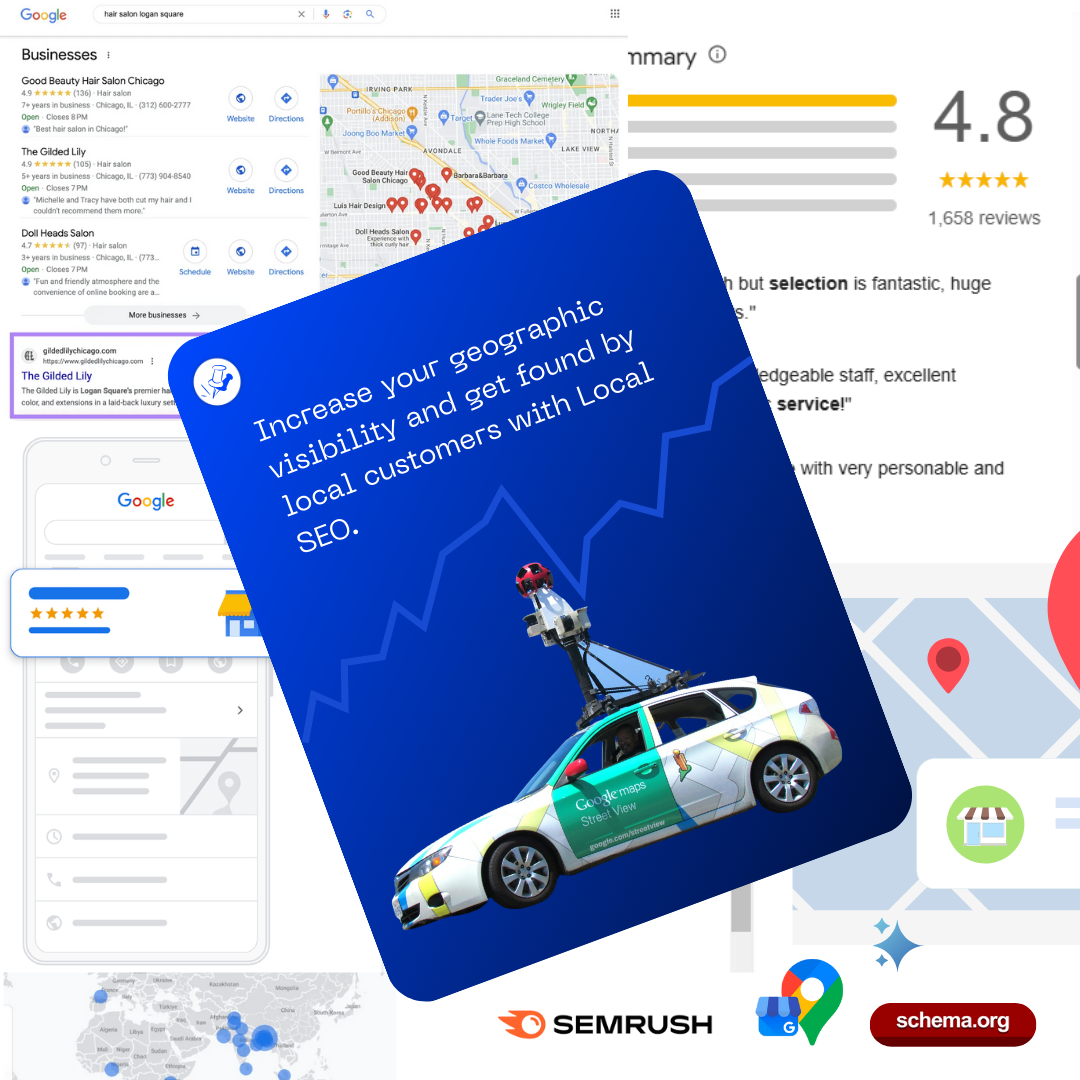
From Map Pack to Front Door
Our Local SEO Services
Local search runs on different signals than national SEO — proximity, prominence and relevance, all judged largely outside your website. We work every one of them. If you also sell beyond your service area, pair this with Business SEO; if you need content that earns local links, add Content Marketing & Optimization.
Your Profile Is the Storefront Google Shows First
Most people decide whether to call you without ever visiting your website. We make sure what they see in that panel does the selling.
Claim, Verify & Lock Down
An unclaimed or half-finished profile is the fastest way to lose a nearby customer to a competitor.
What we do:
- Claim and verify your listing, or recover one you’ve lost access to.
- Correct name, address, hours, service area and phone number.
- Set holiday and special hours so you never show as open when you’re closed.
- Secure the profile against unauthorised edits and suggested changes.
Categories, Services & Attributes
Your primary category has more influence on map rankings than almost anything else on the profile.
What we do:
- Test primary and secondary categories against what’s ranking locally.
- Build out your full service list with descriptions that carry keywords naturally.
- Add attributes buyers filter by — accessibility, payment types, appointments.
- Write a business description that reads to humans, not to a crawler.
Photos, Posts & Q&A
Active profiles get more clicks. Google notices, and so do customers comparing three options.
What we do:
- Upload geotagged photos of your premises, team and work.
- Publish regular Posts for offers, events and updates.
- Seed and answer the Q&A section before a competitor does.
- Keep products and booking links current so the panel stays actionable.

One Wrong Address Can Cost You the Map Pack
Google cross-checks your details across hundreds of sites. Every mismatch weakens its confidence that you are where you say you are.
NAP Audit & Cleanup
Old suite numbers, retired phone lines and abbreviated street names all count against you.
What we do:
- Audit every existing mention of your name, address and phone number.
- Set one canonical format and apply it everywhere.
- Correct outdated details on listings you’d forgotten existed.
- Document the master record so it stays consistent as you grow.
Core Directory Coverage
The data aggregators and major platforms that feed everyone else.
What we do:
- Build or correct listings on Apple Maps, Bing Places and the major aggregators.
- Complete profiles fully rather than submitting the bare minimum.
- Match categories and descriptions to your Google Business Profile.
- Verify each listing so it can’t be edited by third parties.
Industry & Community Citations
Niche directories carry more weight than generic ones, and often send real traffic.
What we do:
- Identify the trade bodies and industry directories that matter in your sector.
- Add local chamber, council and community listings.
- Target the directories your top competitors already appear on.
- Prioritise placements that also earn a followed link.
Duplicate Listing Removal
Duplicates split your reviews and confuse Google about which listing is real.
What we do:
- Find duplicates created by past owners, staff or automated scrapers.
- Merge or remove them through the correct claims process.
- Consolidate reviews onto the surviving listing where possible.
- Monitor for new duplicates appearing over time.

Optimize your website for location-based keywords, improve metadata, and structure content around local relevance to capture more local traffic.
Competitive Keyword Intelligence
Identify competitor-targeted high-value keywords and discover untapped opportunities.
Key points:
Analyze competitor keyword rankings.
Find high-volume, low-competition keywords.
Understand keyword intent (informational, transactional).
Use keyword gap tools for comparison.
Content Strategy Insights
Identify competitor-targeted high-value keywords and discover untapped opportunities.
Key points:
Analyze competitor keyword rankings.
Find high-volume, low-competition keywords.
Understand keyword intent (informational, transactional).
Use keyword gap tools for comparison.
Competitor Backlink Profile Review
Uncover competitors’ strongest links and missed link-building opportunities.
Key points:
Identify top referring domains.
Analyze anchor text diversity.
Find blogs, directories, or partners for pitching.
Reclaim broken backlinks pointing to them.
Gap & Opportunity Mapping
Pinpoint competitor weaknesses and turn them into SEO advantages.
Key points:
Identify missing content topics.
Find keyword rankings on pages 2-3 that you can outrank.
Analyze under-optimized pages for better content.

Develop content tailored to local news, events, and customer interests to build authority in your region and attract more organic visitors.
Scalable SEO Implementation
Apply proven SEO best practices across hundreds or thousands of pages at once.
Key points:
- Standardize URL structures, heading formats, and internal linking across all pages.
- Ensure site-wide technical settings like canonical tags and structured data are correctly applied.
- Avoid manual, page-by-page updates that slow down large-scale optimization.
Dynamic Content Insertion
Automatically populate page elements with relevant, targeted keywords.
Key points:
- Pull keywords dynamically from product names, categories, or database fields.
- Auto-generate SEO-friendly titles, H1 headings, and meta descriptions at scale.
- Reduce duplication by combining static and dynamic text in metadata.
- Maintain flexibility so keywords can be updated centrally without touching each page.
Consistent SEO Elements
Maintain a uniform optimization structure across all templates for stronger search signals.
Key points:
- Use consistent title formats, meta descriptions, heading hierarchies, and structured data.
- Apply the same schema markup standards across all relevant page types.
- Ensure internal linking patterns remain logical and consistent.
- Keep keyword targeting aligned across similar content types to build topical authority.

Encourage positive reviews and help manage your online reputation to increase trust with potential customers and search engines.
URL Mapping & Redirects
Maintain SEO performance during migration by ensuring every old URL points to the correct new page. Accurate 301 redirects help preserve link equity and prevent user drop-offs.
Key points:
- Create a detailed URL mapping document before migration.
- Implement 301 redirects from old URLs to their corresponding new URLs.
- Test all redirects to confirm they work correctly.
- Avoid redirect chains and loops that can slow down page load and hurt rankings.
Backlink Preservation
Track and analyze your SEO performance immediately after the migration to catch issues early.
Key points:
- Monitor keyword rankings daily for significant drops.
- Check Google Search Console for crawl errors or warnings.
- Track organic traffic trends in Google Analytics.
- Quickly fix broken links, missing meta tags, or indexing issues.
Post-Migration Monitoring
Protect the authority and trust signals your site has earned over time by carrying forward valuable backlinks.
Key points:
- Identify all high-value backlinks using SEO tools
- Ensure linked pages are redirected to equivalent new content.
- Update partners or referring sites if their backlinks point to outdated URLs.
- Monitor for lost backlinks and reclaim them quickly.
Technical SEO Checks
Ensure the technical foundation of your site remains strong post-migration to maintain rankings and performance.
Key points:
- Audit indexing status and confirm important pages are included.
- Verify XML sitemap and robots.txt are updated and correct.
- Check site speed and Core Web Vitals.
Ensure meta tags, schema markup, and canonical tags are preserved.

Acquire high-quality local backlinks from respected sources to boost your website’s authority and local rankings.
URL Mapping & Redirects
Maintain SEO performance during migration by ensuring every old URL points to the correct new page. Accurate 301 redirects help preserve link equity and prevent user drop-offs.
Key points:
- Create a detailed URL mapping document before migration.
- Implement 301 redirects from old URLs to their corresponding new URLs.
- Test all redirects to confirm they work correctly.
- Avoid redirect chains and loops that can slow down page load and hurt rankings.
Backlink Preservation
Track and analyze your SEO performance immediately after the migration to catch issues early.
Key points:
- Monitor keyword rankings daily for significant drops.
- Check Google Search Console for crawl errors or warnings.
- Track organic traffic trends in Google Analytics.
- Quickly fix broken links, missing meta tags, or indexing issues.
Post-Migration Monitoring
Protect the authority and trust signals your site has earned over time by carrying forward valuable backlinks.
Key points:
- Identify all high-value backlinks using SEO tools
- Ensure linked pages are redirected to equivalent new content.
- Update partners or referring sites if their backlinks point to outdated URLs.
- Monitor for lost backlinks and reclaim them quickly.
Technical SEO Checks
Ensure the technical foundation of your site remains strong post-migration to maintain rankings and performance.
Key points:
- Audit indexing status and confirm important pages are included.
- Verify XML sitemap and robots.txt are updated and correct.
- Check site speed and Core Web Vitals.
Ensure meta tags, schema markup, and canonical tags are preserved.
Monitor and analyze the effectiveness of our strategies with detailed, actionable reports, ensuring continuous improvement of your local rankings and results.
URL Mapping & Redirects
Maintain SEO performance during migration by ensuring every old URL points to the correct new page. Accurate 301 redirects help preserve link equity and prevent user drop-offs.
Key points:
- Create a detailed URL mapping document before migration.
- Implement 301 redirects from old URLs to their corresponding new URLs.
- Test all redirects to confirm they work correctly.
- Avoid redirect chains and loops that can slow down page load and hurt rankings.
Backlink Preservation
Track and analyze your SEO performance immediately after the migration to catch issues early.
Key points:
- Monitor keyword rankings daily for significant drops.
- Check Google Search Console for crawl errors or warnings.
- Track organic traffic trends in Google Analytics.
- Quickly fix broken links, missing meta tags, or indexing issues.
Post-Migration Monitoring
Protect the authority and trust signals your site has earned over time by carrying forward valuable backlinks.
Key points:
- Identify all high-value backlinks using SEO tools
- Ensure linked pages are redirected to equivalent new content.
- Update partners or referring sites if their backlinks point to outdated URLs.
- Monitor for lost backlinks and reclaim them quickly.
Technical SEO Checks
Ensure the technical foundation of your site remains strong post-migration to maintain rankings and performance.
Key points:
- Audit indexing status and confirm important pages are included.
- Verify XML sitemap and robots.txt are updated and correct.
- Check site speed and Core Web Vitals.
Ensure meta tags, schema markup, and canonical tags are preserved.
How We Work
Four stages, clear deliverables at each one — from first audit to the calls that follow.
Audit
Profile, citations, reviews and site — benchmarked against the competitors already ranking near you.
Optimize
Google Business Profile, NAP consistency and location pages rebuilt to compete on proximity and relevance.
Promote
Reviews, community links and local content that build the prominence Google is looking for.
Measure
Grid rank tracking plus calls and direction requests, reported monthly with next steps attached.
Why Local Businesses Work With Us
We Turn Every Click, View & Scroll into Your Edge with Your Existing Data Existing Data Existing Data
Built Around Your Actual Service Area
A single-site restaurant and a twelve-van trades business need completely different local strategies. We build around your radius, your competition and your margins — not a package tier.
Measured in Calls, Not Rankings
Grid rank tracking shows where you're visible across your whole area, and conversion tracking shows what it produced. You see the leads, not just a position number.
Every Local Signal, Not Just the Profile
Rankings come from proximity, prominence and relevance — profile, citations, reviews, links and on-page all together. Optimising one and ignoring the rest is why most local SEO stalls.
Maintained, Not Set and Forgotten
Competitors open, hours change, duplicate listings appear, reviews land. Local SEO decays without upkeep, so we monitor and adjust every month rather than delivering once and moving on.
FAQ's
How long until I show up in the map pack?
Profile and citation fixes often move things within 4–8 weeks, especially if your listing was incomplete or your details were inconsistent. Competitive urban areas take longer — usually 3–6 months to hold a top-three position consistently, because reviews and local links take time to accumulate.
Do I need a physical address to rank locally?
No. Service-area businesses can rank without displaying an address, as long as the profile is set up correctly as a service-area business and your service radius is defined properly. What you can’t do is use a virtual office or a mailbox address — Google actively removes those listings.
What's the difference between local SEO and regular SEO?
Local SEO targets people searching near a location, so much of the work happens off your website — Google Business Profile, citations, reviews and local links. Regular SEO targets buyers wherever they are and lives mostly on your site. If you serve a defined area and also sell more broadly, you want both. See Business SEO.
Can you help with more than one location?
Yes. Multi-location work means a separate optimised profile per site, distinct location pages that don’t cannibalise each other, and consistent NAP data across every branch. We report rankings and conversions per location so you can see which sites are performing and which need attention.
Free, No Obligation
See Where You Rank Across Your Service Area
Send us your business name and postcode. We’ll come back with a grid showing exactly where you appear in the map pack, who’s outranking you, and the three fixes that will move you fastest.