
Google Ads That Stop Wasting Your Budget.
Most accounts we audit are burning 30–40% of spend on searches that were never going to convert. We find that money first, redirect it to the terms that produce customers, and manage the account daily so it stays that way.
Why Google Ads Still Works
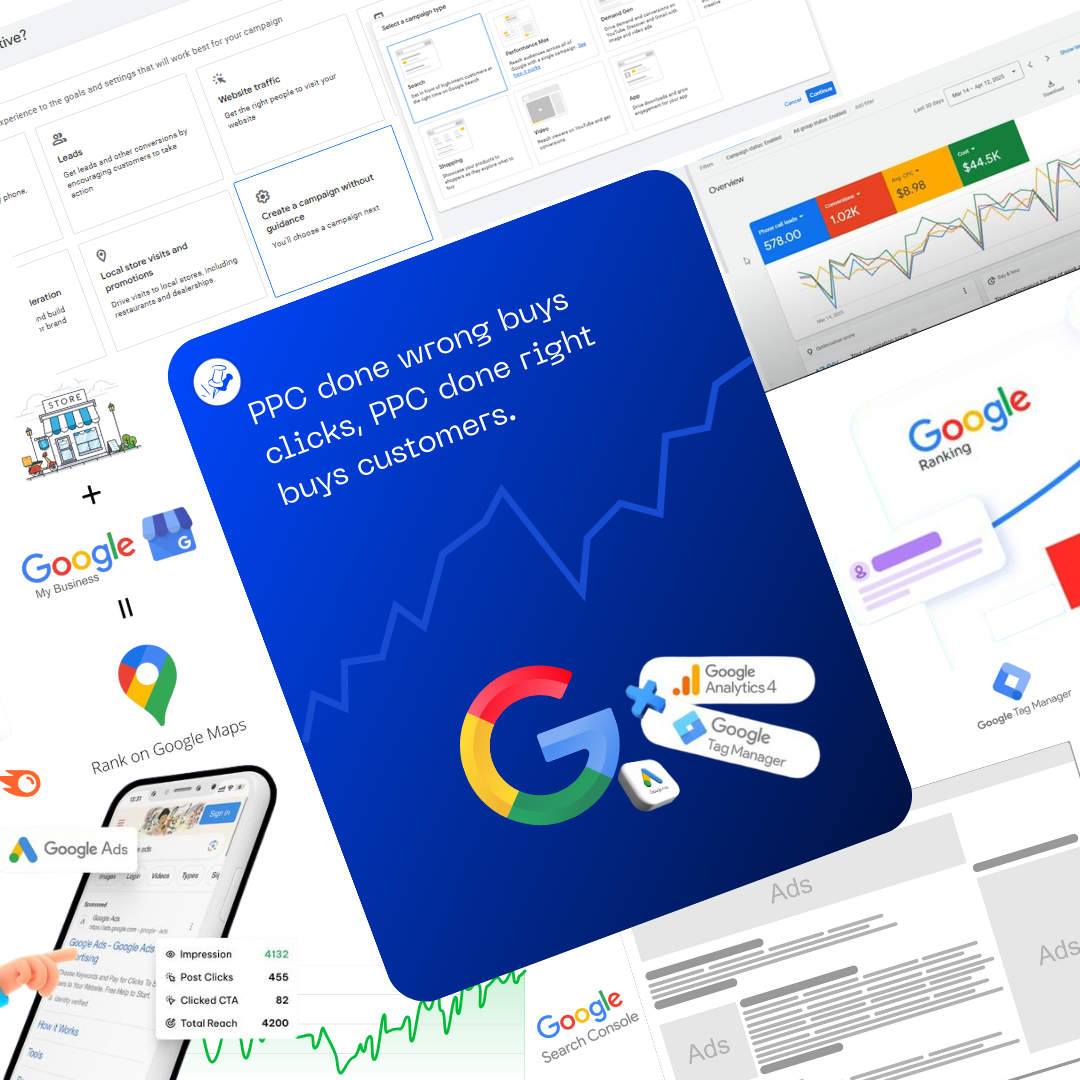
Managed Daily, Reported Monthly
What You Get With Google Ads Management
Six workstreams covering the full account — structure, targeting, creative, landing pages, tracking and remarketing. Paid and organic work best together: ads tell us which keywords convert before Business SEO invests months chasing them, and your landing page content decides whether the clicks turn into anything.
Structure Decides What Your Clicks Cost
A messy account overpays for everything. Get the architecture right and the same budget buys substantially more.
Account Structure & Campaign Architecture
Campaigns organised around how you actually make money, not around how the default setup wizard suggested.
What we do:
- Split campaigns by service, margin and geography so budget follows profit.
- Build tightly themed ad groups instead of everything-in-one buckets.
- Restructure inherited accounts without losing conversion history.
- Keep naming conventions clean so reporting stays readable.
Bidding Strategy & Budget Control
Automated bidding works well — once it has clean data and sensible limits.
What we do:
- Choose bidding strategy based on your conversion volume, not on defaults.
- Set targets from your actual margins and close rate.
- Move budget toward campaigns proving return, away from those that aren’t.
- Adjust by device, location, day and hour where the data justifies it.
Search, Shopping, Display & Performance Max
The right campaign types for your business — and honest advice about the ones you don’t need.
What we do:
- Run Search as the foundation, since intent is highest there.
- Set up Shopping feeds properly for ecommerce.
- Use Performance Max deliberately, with brand exclusions and asset control.
- Deploy Display and video only where they earn their place.
Daily Management & Optimization
Accounts drift. Weekly check-ins aren’t management.
What we do:
- Review search terms and performance data daily, not monthly.
- Pause what’s failing before it eats a week of budget.
- Respond quickly to competitor bidding changes.
- Keep a change log so every adjustment is traceable.

Pay for Buyers, Not Browsers
The difference between a profitable account and an expensive one is usually which searches you’re willing to pay for — and which you refuse to.
Commercial Intent Keyword Selection
High volume is not the goal. Ready-to-buy is.
What we do:
- Prioritise terms that signal an imminent purchase decision.
- Estimate realistic cost per lead before committing budget.
- Leave research-stage terms to organic content where they belong.
- Find lower-competition terms your competitors have overlooked.
Match Types & Search Term Discipline
Broad match without supervision is the fastest way to lose money in this platform.
What we do:
- Use exact and phrase match where control matters most.
- Test broad match only with tight budgets and close monitoring.
- Review the search terms report continuously, not occasionally.
- Promote proven search terms into their own keywords.
Negative Keyword Management
The single highest-return activity in most accounts, and the most commonly skipped.
What we do:
- Build negative lists from day one — jobs, free, DIY, competitors, wrong intent.
- Maintain shared lists across campaigns.
- Add new negatives weekly from live search term data.
- Stop campaigns cannibalising each other’s traffic.
Audience & Geographic Layering
Same keyword, very different value depending on who’s searching and from where.
What we do:
- Layer in-market and remarketing audiences onto search campaigns.
- Target the locations that actually convert and exclude the rest.
- Set location settings to presence, not interest — a common expensive default.
- Adjust bids by audience value rather than treating all clicks equally.

Ads That Earn the Click and Filter the Wrong One
Good ad copy does two jobs: it wins qualified clicks and it discourages unqualified ones. Both save you money.
Responsive Search Ad Development
Enough strong assets for Google to assemble a good ad, with the messaging still under your control.
What we do:
- Write distinct headlines covering benefits, proof, offer and objections.
- Pin critical messaging where it must not be rearranged.
- Include the keyword naturally to protect relevance and Quality Score.
- Match the promise to what the landing page actually delivers.
Ad Assets & Extensions
Free real estate that increases click-through and pushes competitors down the page.
What we do:
- Build sitelinks, callouts and structured snippets for every campaign.
- Add call, location and lead form assets where they suit the business.
- Use price and promotion assets to pre-qualify clicks.
- Review asset performance and replace weak ones.
Qualifying Copy
Stating your price range or minimum in the ad costs you clicks you didn’t want anyway.
What we do:
- Signal pricing tier or minimum engagement where appropriate.
- Name the audience you serve so others self-select out.
- Set expectations honestly to improve lead quality downstream.
- Track lead quality alongside volume, not instead of it.
Continuous Ad Testing
Ad performance decays. Testing is a permanent process, not a launch task.
What we do:
- Run structured tests on one variable at a time.
- Let tests reach significance before calling a winner.
- Rotate in fresh copy as performance flattens.
- Feed winning angles back into landing pages and organic content.

The Click Is Only Half of What You Paid For
Sending paid traffic to your homepage wastes most of it. Doubling conversion rate halves your cost per lead without touching the ad budget.
Conversion-Focused Page Structure
Dedicated pages that continue the conversation the ad started.
What we do:
- Build a landing page per campaign theme instead of a catch-all page.
- Match headline and offer to the ad that was clicked.
- Lead with the outcome, then proof, then a single clear action.
- Strip navigation and links that leak traffic away.
Speed & Mobile Experience
Most paid clicks arrive on a phone. A slow page is money already spent and lost.
What we do:
- Optimise load time — paid traffic is unforgiving of delay.
- Design mobile-first rather than shrinking the desktop layout.
- Make tap targets and forms genuinely usable on small screens.
- Fix layout shift that causes accidental taps and bounces.
Form & Friction Reduction
Every extra field costs you conversions. Ask for what you need to make the next call.
What we do:
- Cut fields to the minimum that still qualifies a lead.
- Offer alternative contact routes — call, WhatsApp, callback.
- Add trust signals near the point of action.
- Make the thank-you page work rather than dead-ending.
A/B Testing Programme
Landing page testing usually returns more than bid tinkering.
What we do:
- Test headlines, offers, form length and calls to action.
- Run one variable at a time to significance.
- Use heatmaps and recordings to find where people stall.
- Roll winners across the account.

If the Tracking Is Wrong, Everything Downstream Is Wrong
Broken conversion tracking is the most common problem we find in inherited accounts — and it means Google’s automated bidding has been optimising toward the wrong thing all along.
Conversion Setup & Validation
Verified end to end, not assumed because a tag is present.
What we do:
- Configure conversion actions for calls, forms, chats and purchases.
- Test every path manually before trusting the data.
- Remove duplicate and inflated conversions that distort bidding.
- Set values so Google optimises toward revenue, not raw count.
Call Tracking
For most service businesses the phone is the real conversion, and it’s usually untracked.
What we do:
- Implement dynamic number insertion tied to campaign source.
- Set minimum call duration so misdials don’t count as leads.
- Attribute calls back to keyword and ad where possible.
- Review recordings periodically to check lead quality.
Lead Quality Feedback Loops
A hundred cheap leads that never close is a worse outcome than twenty that do.
What we do:
- Import offline conversions from your CRM where available.
- Distinguish enquiries from qualified opportunities in reporting.
- Feed close-rate data back into bidding and targeting.
- Identify which keywords produce leads that actually buy.
GA4 Integration & Wasted Spend Reporting
The uncomfortable numbers, reported plainly.
What we do:
- Link Ads and GA4 so paid behaviour is visible beyond the click.
- Report spend that produced nothing, every month.
- Compare paid against organic performance on the same terms.
- See Event Tracking & Analysis for the wider analytics setup.

Most Buyers Don’t Convert on the First Visit
You’ve already paid to bring them once. Remarketing is almost always the cheapest conversion in the account — as long as it isn’t run as a blanket follow-everyone campaign.
Audience Segmentation by Behaviour
Someone who abandoned a quote form is nothing like someone who bounced off a blog post.
What we do:
- Build audiences by pages visited, depth and time on site.
- Separate cart or form abandoners for priority targeting.
- Segment by recency, since intent decays fast.
- Exclude existing customers unless there’s a genuine upsell.
Sequenced Messaging
Show the same ad twenty times and you train people to ignore you.
What we do:
- Change the message as time since visit increases.
- Lead with proof and reviews for warm audiences.
- Hold offers and incentives back for later in the sequence.
- Set an end point rather than following people indefinitely.
Dynamic Remarketing
For ecommerce and multi-service businesses, showing the exact thing they looked at.
What we do:
- Set up and maintain the product or service feed.
- Serve ads featuring the specific items viewed.
- Include price and availability so ads stay accurate.
- Add complementary items where it makes sense.
Frequency Control & Exclusions
Over-served ads cost money and damage brand perception.
What we do:
- Cap impressions per user per period.
- Exclude converters immediately.
- Block low-quality placements and apps burning display budget.
- Monitor sentiment as well as cost per conversion.
How It Works
Four stages, from finding the wasted spend to scaling what works.
Audit & Strategy
We find the wasted spend, check whether tracking is even accurate, and set targets from your real margins.
Setup & Optimization
Restructured campaigns, tight targeting, fresh ad copy and landing pages built to convert the traffic.
Scale
Daily management, continuous testing, and budget moved toward whatever is proving return.
Optimization & Publishing
Monthly reporting on cost per lead and lead quality — including the spend that produced nothing.
What Makes Our PPC Management Different
We Turn Every Click, View & Scroll into Your Edge with Your Existing Data Existing Data Existing Data
We Start by Finding the Leak
Before adding budget, we find what's being wasted. Most accounts have negative keyword gaps and broken conversion tracking costing more than any bid adjustment will save.
We Report the Waste Too
Every monthly report includes spend that produced nothing and what we did about it. Agencies that only report wins are hiding the other half.
Lead Quality, Not Lead Count
Cheap leads that never close are the easiest metric to hit and the least useful. We track through to qualified opportunities and optimise for those.
Landing Pages Included
We don't hand you traffic and blame your website. Landing page structure, speed and testing are part of the engagement, because that's where half the return is.
You Own the Account
Your Google Ads account stays in your name with full admin access. If you ever leave, the account, data and history go with you. No hostage arrangements.
Paid and Organic, Together
Ad data tells us which keywords convert before SEO spends months chasing them. Running both means each one makes the other cheaper.
FAQ's
What's the minimum budget worth starting with?
It depends entirely on your cost per click and how many conversions you need before the data means anything. In low-cost sectors a modest budget works; in competitive B2B where clicks run high, the same amount buys too few clicks to optimise from. We’ll tell you honestly at audit stage whether your budget can realistically compete — and if it can’t, we’ll say so rather than take the retainer.
How do you charge — flat fee or percentage of spend?
We’ll set this out clearly before you commit. The thing worth understanding is the incentive: percentage-of-spend models reward the agency for spending more, which isn’t always in your interest. Whatever structure we agree, you’ll know exactly what you’re paying for management versus what’s going to Google.
How long before Google Ads becomes profitable?
Traffic starts immediately, but the first 4–6 weeks are largely a learning period — for the algorithm and for us. Expect cost per lead to fall meaningfully by month two or three as negatives build up and bidding settles. Anyone promising profitability in week one either has unusually easy economics or isn’t being straight with you.
Should I run Google Ads or invest in SEO?
Ads if you need leads this quarter, SEO if you want cost per lead falling over years. Most businesses that can afford both should run both — ads reveal which keywords actually convert, which makes the SEO investment far better targeted, and organic rankings eventually reduce how much you need to bid.
Can you take over an existing account?
Yes, and usually that’s better than starting over — the conversion history has real value for automated bidding. We audit first, then restructure in stages rather than rebuilding overnight and losing that history. If the account is genuinely beyond repair we’ll tell you and explain why.
Free, No Obligation
Find Out How Much of Your Ad Spend Is Being Wasted
Give us read access to your Google Ads account. We’ll come back with the search terms costing you money, whether your conversion tracking is actually working, and the three changes that will lower your cost per lead fastest.